
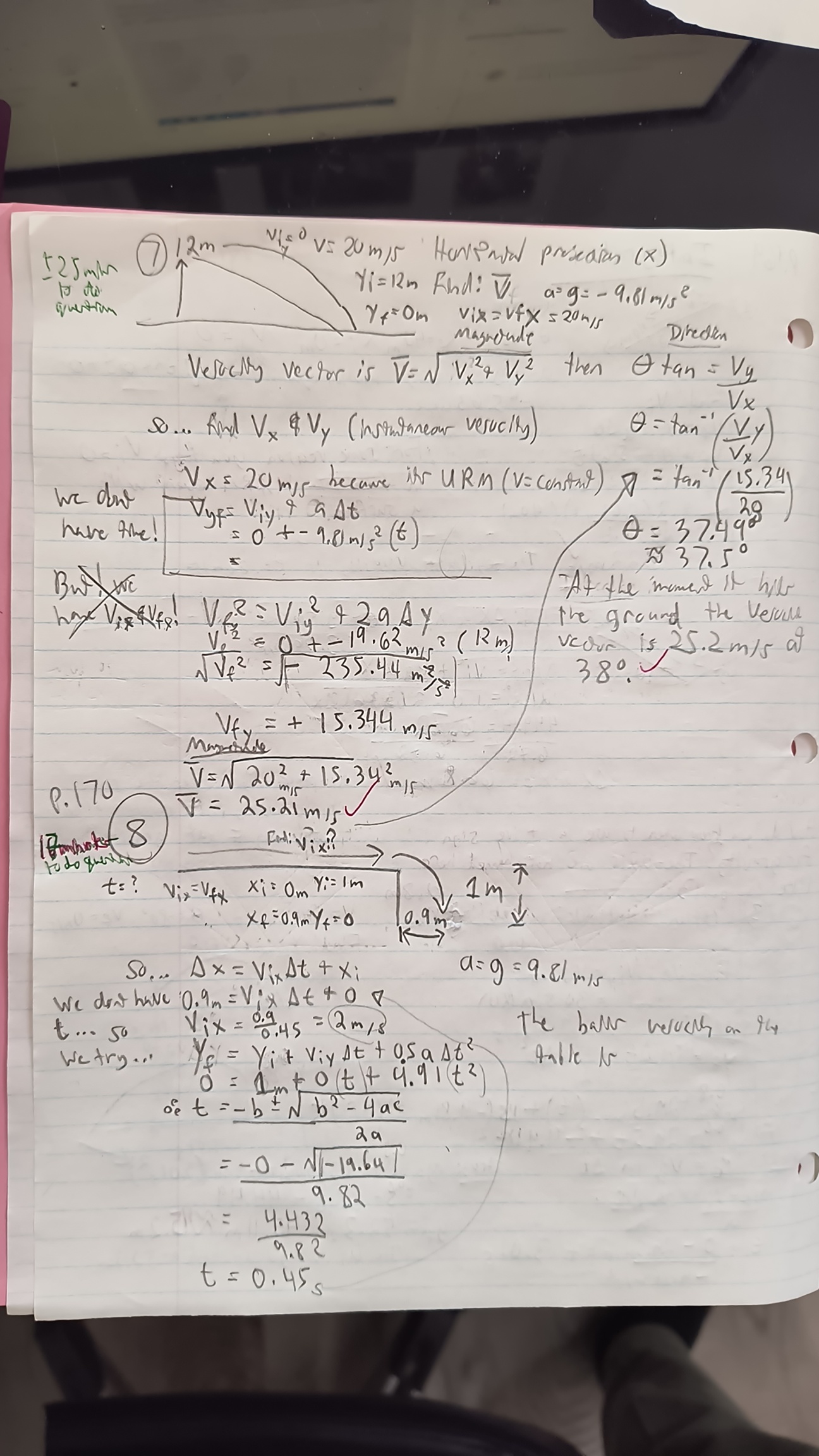

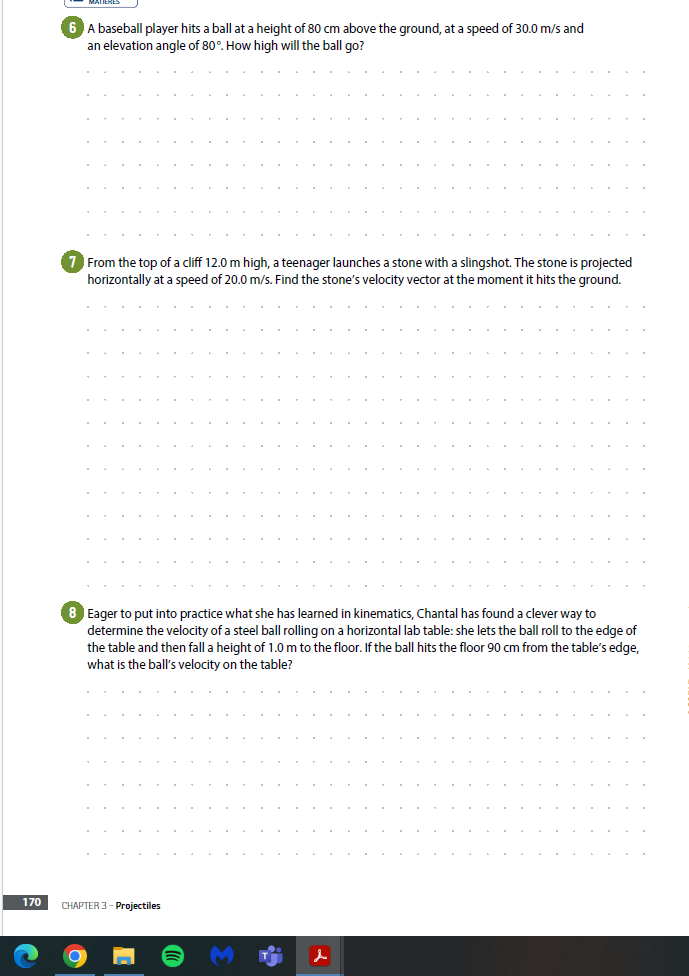
Is initial velocity zero from a vertical component point of view in UARM when dealing with projectiles; not only in free fall but if something is launched initially would initial velocity be zero given no angle in the question? Usually when an angle is givin we use: viy = vi sin theta then our velocity for viy is not zero. But when we are not given an angle of where the object is launched and the object goes up then down, where the object is at its highest (vertex) velocity of y is 0 same as the beginning of a free falling object. BUT, when an object is launched horizontally...(not obliquely obviously) and we are not given a direction (angle) can we say initial velocity is 0 like a free falling object for y? I'll give you an example for context. page 170, chapter 3, number 7 and 8.
Also, when I have a square root with a negative number I often use the absolute value and get the correct answer. Is this ok or did I do something wrong and will marks on my exam?








Explication d'Alloprof
Cette explication a été donnée par un membre de l'équipe d'Alloprof.
Hi !
The speed depends on the situation in UARM.
Ce contenu est protégé par le droit d'auteur. Toute reproduction à l'extérieur des forums Alloprof est interdite et pourra être considérée comme une violation du droit d'auteur.
And yes, when the exercise states that the projectile is launched horizontally, it means that the angle is 0 with \(v_y=0\).
Also, if while using the UARM formulas, you get the square root of a negative number, it indicates that there might be an issue with your reference or how you are using it.
I hope this helps and if you have any other questions, feel free to ask them.
Have a nice day !
Suggestions en lien avec la question
Suggestion en lien avec la question
Voici ce qui a été trouvé automatiquement sur le site, en espérant que ça t’aide!