Subjects
Grades
Fiction genres are categories of stories, classified according to certain characteristics of tone, content, form and technique.
The main purpose of genres is classification.
From a writer’s perspective, the classification offers a guideline according to the given characteristics of a genre.
From a reader’s perspective, the classification offers a set of expectations and apprehensions according to the given characteristics of a genre.
Keep in mind that genres aren’t rules to be followed: they are guidelines to be played with. Experienced writers will bend genres, mix them and use the reader’s expectations to create an interesting reading experience
There are countless genres and subgenres, with new ones being created regularly.
Here are some of the more common fiction genres in literature with their prevalent features.
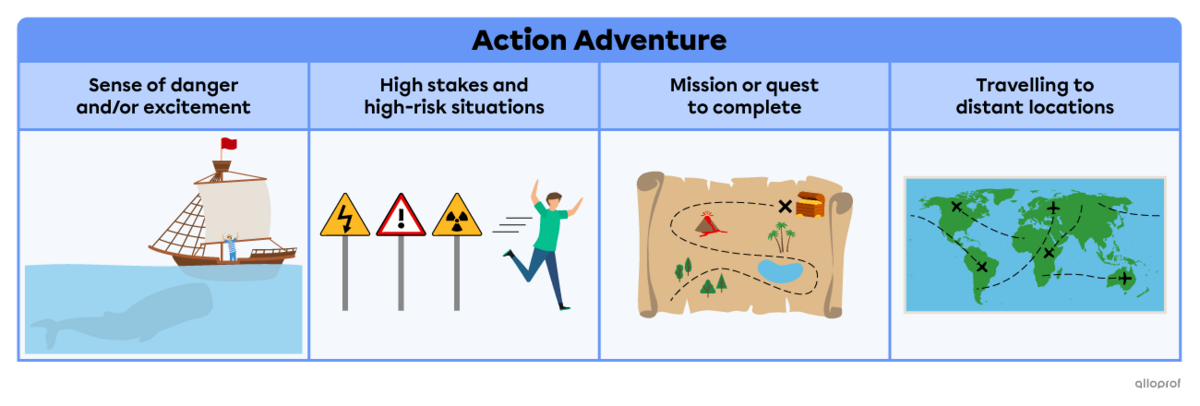
| Treasure Island (Stevenson, 1882) | |
| What makes it action/adventure? | Search for a pirate treasure |
| Traveling the seas on a ship | |
| Dangerous hidden agendas | |
| Quote | “The Hispaniola still lay where she had anchored; but, sure enough, there was the Jolly Roger—the black flag of piracy—flying from her peak.” |
| The Life of Pi (Martel, 2001) | |
| What makes it action/adventure? | Disastrous shipwreck |
| Lost at sea for a long time | |
| Stuck on a raft with a tiger | |
| Quote | “It is pointless to say that this or that night was the worst of my life. I have so many bad nights to choose from that I've made none the champion.” |
| Casino Royale (Fleming, 1953) | |
| What makes it action/adventure? | Introduction of the James Bond character |
| Spying and intrigue | |
| Cold War setting | |
| Quote | “History is moving pretty quickly these days and the heroes and villains keep on changing parts.” |
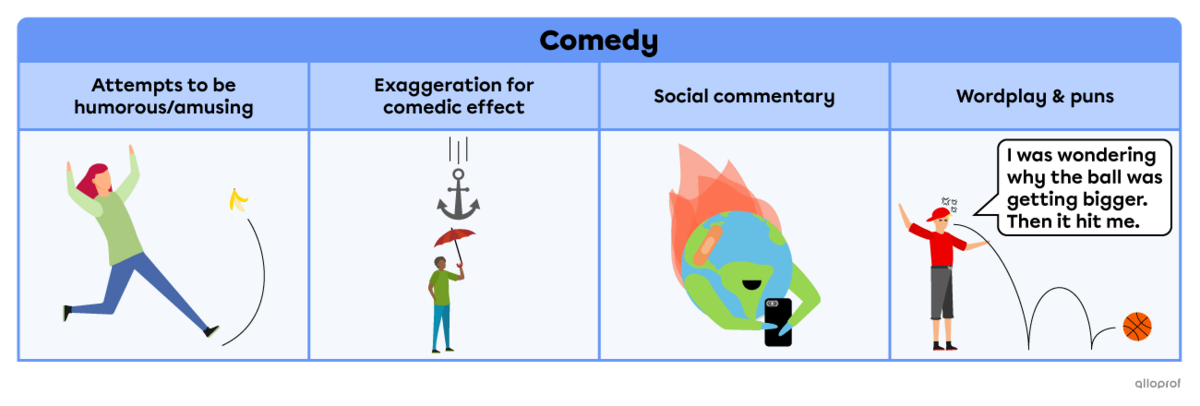
| The Hitchhiker's Guide to the Galaxy (Adams, 1979) | |
| What makes it a comedy? | Witty turn of phrases |
| Premise: A human is dragged into a space adventure by an alien posing as human when the Earth is destroyed to make way for an intergalactic highway. | |
| Character interactions (human, aliens & robots) | |
| Quote | “Space is big. You just won't believe how vastly, hugely, mind-bogglingly big it is. I mean, you may think it's a long way down the road to the chemist's, but that's just peanuts to space.” |
| Good Omens (Pratchett & Gaiman, 1990) | |
| What makes it a comedy? | Narrator’s comments and observations |
| Premise: a baby mix-up causes the Antichrist to be misplaced, delaying the Apocalypse. | |
| Protagonists are an angel and a demon who become friends | |
| Quote | “Evil in general does not sleep, and therefore doesn't see why anyone else should.” |
| A Midsummer Night’s Dream (Shakespeare, 1595) | |
| What makes it a comedy? | Exaggerated situations: mistaken identities |
| Light tone: puns and wordplays | |
| Comic characters: comic relief | |
| Quote | “Methinks, mistress, you should have little reason for that. And yet, to say the truth, reason and love keep little company together nowadays” |
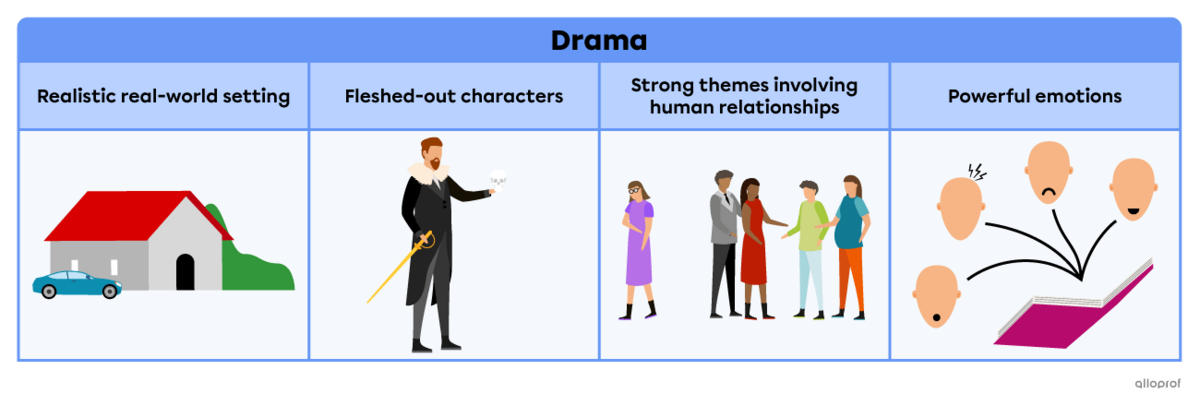
| The Great Gatsby (Fitzgeralld, 1925) | |
| What makes it a drama? | Fleshed out characters |
| Social comment on the excess of the Roaring Twenties | |
| The narration has a reflective style | |
| Quote | “I couldn’t forgive him or like him, but I saw that what he had done was, to him, entirely justified. It was all very careless and confused.” |
| The Help (Stockett, 2009) | |
| What makes it a drama? | Theme: racial discrimination |
| Fleshed out characters | |
| Context: during civil rights movement | |
| Quote | “I always order the banned books from a black market dealer in California, figuring if the State of Mississippi banned them, they must be good.” |
| Hamlet (Shakespeare, 1601) | |
| What makes it a drama? | Tragic hero: Hamlet |
| Internal and external conflicts | |
| Themes: revenge, betrayal and death | |
| Quote | “Doubt thou the stars are fire; Doubt that the sun doth move; Doubt truth to be a liar; But never doubt I love.” |
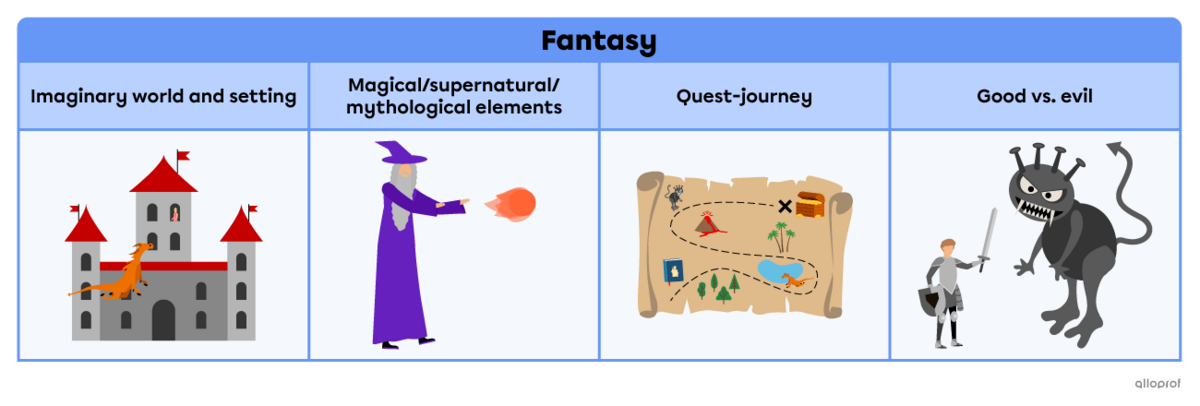
| The Fellowship of the Ring (Tolkien, 1954) | |
| What makes it fantasy? | Good vs evil: the fellowship vs Sauron |
| Magic: the One Ring, dragons, elves… | |
| Quest: destroying the power ring | |
| Quote | “Well, you can go on looking forward," said Gandalf. "There may be many unexpected feasts ahead of you.” |
| The Princess Bride (Goldman, 1973) | |
| What makes it fantasy? | Fairy tale-like setting |
| Magic: potions, miracle workers | |
| True love as a power | |
| Quote | “You seem a decent fellow," Inigo said. "I hate to kill you." You seem a decent fellow," answered the man in black. "I hate to die.” |
| Harry Potter and the Philosopher’s Stone (Rowling, 1997) | |
| What makes it fantasy? | Imaginary world: hidden wizard world |
| Magic: sorcery, goblins, trolls… | |
| Quest: Harry, the chosen one | |
| Quote | “I can teach you how to bewitch the mind and ensnare the senses. I can tell you how to bottle fame, brew glory, and even put a stopper in death.” |
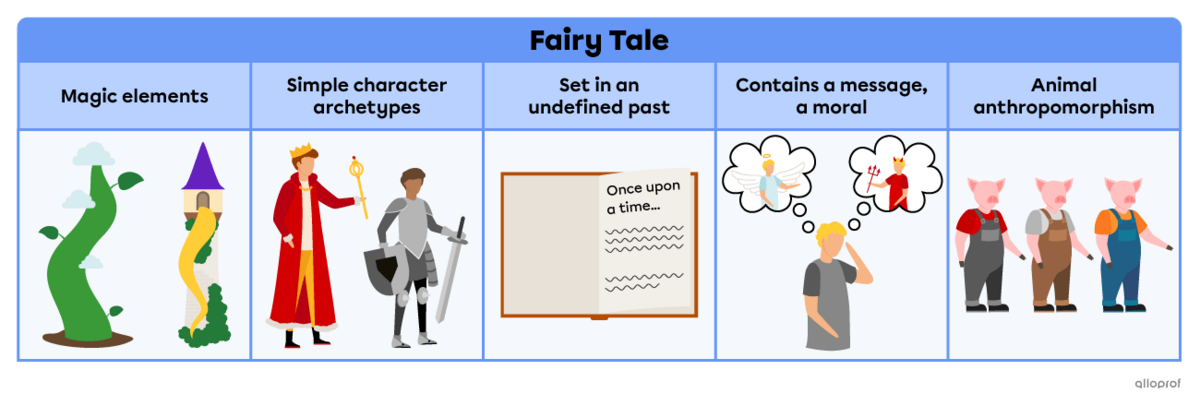
| The Little Mermaid (Andersen, 1836) | |
| What makes it fairy tale? | A magical underwater kingdom |
| Moral about longing | |
| Quote | “At first she was overjoyed that he would be with her, but then she recalled that human people could not live under the water, and he could only visit her father's palace as a dead man.” |
| Hansel and Gretel (collected by the Brothers Grimm, 1812) | |
| What makes it fairy tale? | The enchanted gingerbread house |
| The moral about greed | |
| Quote | "You're nothing but skin and bones!" said the witch, locking Hansel into a cage. I shall fatten you up and eat you!" |
| The Beauty and the Beast (collected by Lang, 1889) | |
| What makes it fairy tale? | The transformation of the Beast |
| The moral about inner beauty | |
| Quote | “Monsters are more effective than princes when it comes to keeping what you care about safe.” |
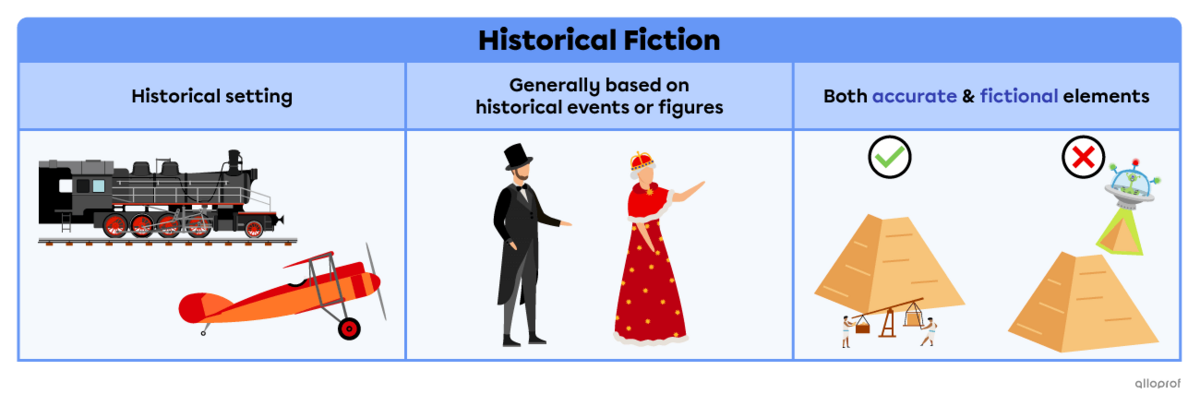
| The Pillars of the Earth (Follett, 1989) | |
| What makes it historical fiction? | Set in the 12th century, in England |
| Fictional main characters | |
| Accurate depiction of architecture and technology for the period | |
| Quote | “When things are simple, fewer mistakes are made. The most expensive part of a building is the mistakes.” |
| A Tale of Two Cities (Dickens, 1859) | |
| What makes it historical fiction? | Set in the 18th century, during the French Revolution |
| Fictional main characters in parallel storylines | |
| Accurate depiction of the Reign of terror, the storming of the Bastille and the aristocracy | |
| Quote | “It was the best of times, it was the worst of times, it was the age of wisdom, it was the age of foolishness, it was the epoch of belief, it was the epoch of incredulity, it was the season of light, it was the season of darkness, it was the spring of hope, it was the winter of despair.” |
| The Boy in the Striped Pajamas (Boyne, 2006) | |
| What makes it historical fiction? | Set during World War II |
| Main characters and climax story events are both fictional | |
| Accurate depiction of the Holocaust, the Auschwitz camp and the Final Solution | |
| Quote | “What exactly was the difference? He wondered to himself. And who decided which people wore the striped pajamas and which people wore the uniforms?” |
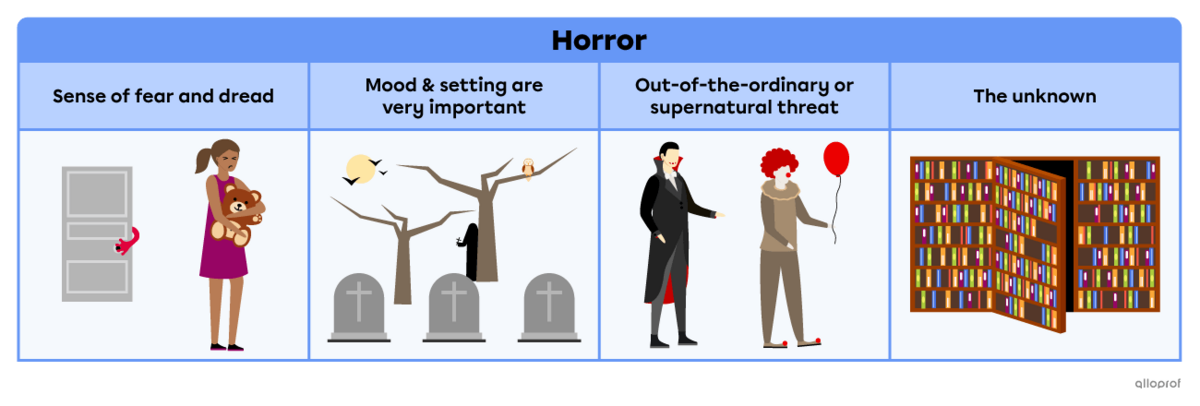
| Frankenstein (Shelley, 1818) | |
| What makes it horror? | Threat: the Frankenstein monster |
| Fear: consequences of creating life | |
| Setting: bleak and dark—gothic | |
| Quote | “...I saw the dull yellow eye of the creature open; it breathed hard, and a convulsive motion agitated its limbs.” |
| The Terror (Simmons, 2007) | |
| What makes it horror? | Threats: the environment and the monster |
| Setting: the isolated Arctic | |
| Fear: starvation, madness and freezing to death | |
| Quote | “In this cold, teeth can shatter after two or three hours—actually explode—sending shrapnel of bone and enamel flying inside the cavern of one’s clenched jaws.” |
| At the Mountains of Madness (Lovecraft, 1936) | |
| What makes it horror? | Threat: ancient evil powers |
| The unknown: understanding leads to madness | |
| Setting: isolated in Antarctica | |
| Quote | “What we did see—for the mists were indeed all too malignly thinned—was something altogether different, and immeasurably more hideous and detestable. It was the utter, objective embodiment of the fantastic novelist’s “thing that should not be”;” |
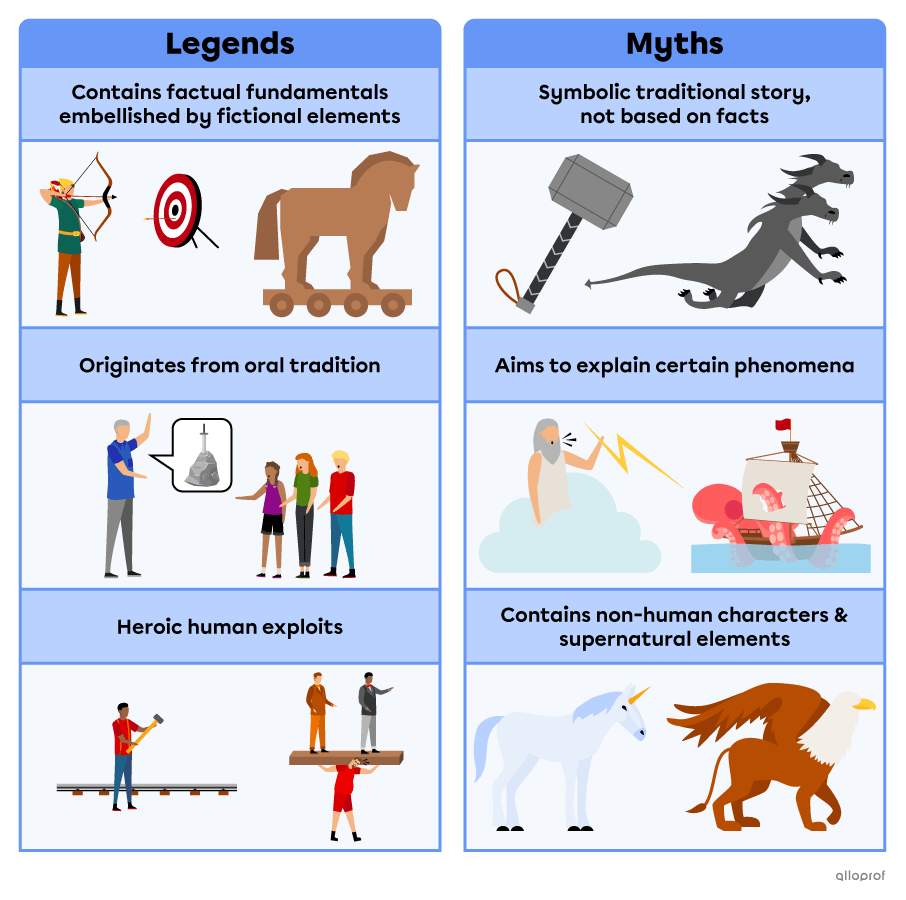
| Legend examples | |
| The legend of Robin Hood (14th century) | |
| What makes it a legend? | Based on a man that may or may not have existed in the 12th or 13th century. |
| Steals from the rich to give to the poor | |
| The legend of King Arthur (12th century) | |
| What makes it a legend? | Based on a character from 6th century poems—his existence is debated |
| Lead armies to defeat invaders | |
| The legend of Robert Johnson (1930s) | |
| What makes it a legend? | Based on an American blues musician (1911-1938) |
| Sold his soul to the devil to become a great musician. | |
| Myths examples | |
| Prometheus stealing fire from the gods to give it to humankind (8th century B.C.) | |
| What makes it a myth? | Symbolism: fire represents knowledge and advancement (i.e. technology) |
| Supernatural elements: Olympian beings and gods Greek mythology | |
| Pandora’s box (7th century B.C. | |
| What makes it a myth? | Symbolism: the box represents human curiosity and its possible repercussions |
| Supernatural elements: the enchanted box itself. | |
| Ragnarök (8th century) | |
| What makes it a myth? | Symbolism: rebirth |
| Supernatural elements: gods of Norse mythology. | |
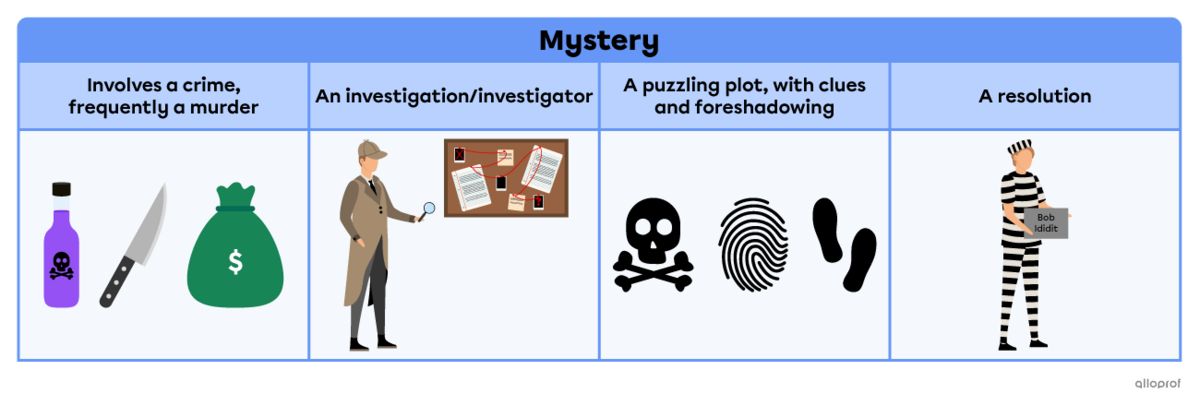
| Murder on the Orient Express (Christie, 1934) | |
| What makes it horror? | a murder |
| several likely suspects | |
| protagonist investigator: Hercules Poirot | |
| Quote | “But I know human nature, my friend, and I tell you that, suddenly confronted with the possibility of being tried for murder, the most innocent person will lose his head and do the most absurd things.” |
| Shutter Island (Lehane, 2003) | |
| What makes it horror? | investigation of a disappearance |
| clues pointing to a much more complex mystery | |
| protagonists: 2 detectives | |
| Quote | “It’s an island, boss. They’ll always find us.” Teddy met Chuck’s eyes and nodded. For the first time since they’d met, he could see fear in Chuck’s eyes, his jaw trying to tighten against it. |
| The Hound of the Baskervilles (Conan Doyle, 1902) | |
| What makes it horror? | a mysterious death |
| resolution by deduction from clues | |
| protagonist investigator: Sherlock Holmes | |
| Quote | “The more outré and grotesque an incident is the more carefully it deserves to be examined.” |
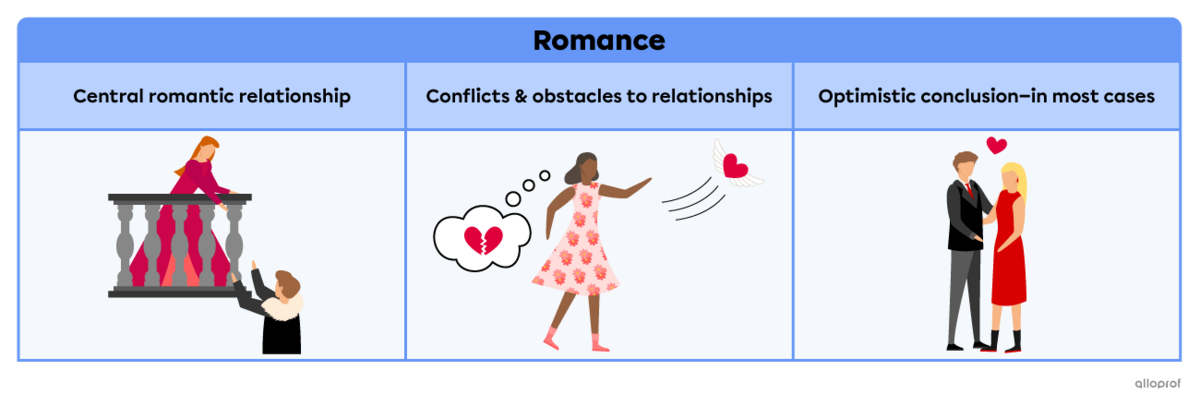
| Outlander (Gabaldon, 1991) | |
| What makes it horror? | Centers on the love story between the 2 protagonists |
| Obstacles: cultural and historical conflicts between the characters | |
| Two love interests for the female protagonist | |
| Quote | “For where all love is, the speaking is unnecessary. It is all. It is undying. And it is enough” |
| Gone with the Wind (Mittchell, 1935) | |
| What makes it horror? | Centers on the love story between the 2 protagonists |
| Obstacles: social class and the American Civil War | |
| A satisfying resolution | |
| Quote | “Hush," he said. "I am asking you to marry me. Would you be convinced if I knelt down?” |
| The Notebook (Sparks, 1996) | |
| What makes it horror? | Centers on the love story between the 2 protagonists |
| A protagonist is already engaged to be married | |
| Obstacles: social classes, distance and sickness | |
| Quote | “The romantics would call this a love story, the cynics would call it a tragedy.” |
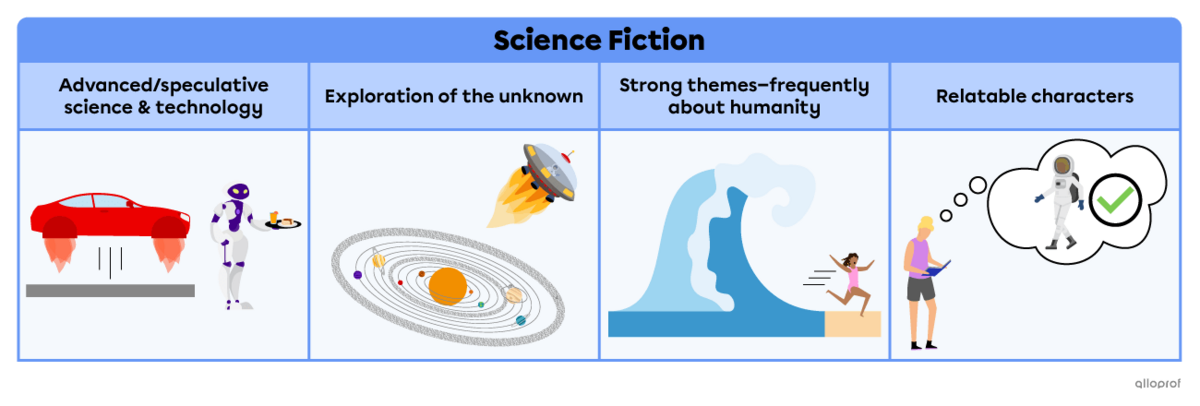
| 1984 (Orwell, 1949) | |
| What makes it horror? | Speculative tech: surveillance and video phones |
| Themes: truth and perception | |
| Quote | “Doublethink means the power of holding two contradictory beliefs in one's mind simultaneously, and accepting both of them.” |
| Dune (Herbert, 1965) | |
| What makes it horror? | Advanced tech: space travel |
| Themes: power and leadership | |
| Quote | “Science is made up of so many things that appear obvious after they are explained.” |
| Foundation (Asimov, 1951) | |
| What makes it horror? | Speculative tech: psychohistory science to predict the future |
| Themes: the individual vs the collective | |
| Quote | “Through hyper-space, that unimaginable region that was neither space nor time, matter nor energy, something nor nothing, one could traverse the length of the Galaxy in the interval between two neighboring instants of time.” |
Subgenres in fiction are subcategories of genres. They are more specialized and specific than the broader fiction genres. There is an unlimited number of possible subgenres.
Common Fiction Subgenres in Literature
Keep in mind that there is a considerable number of subgenres. These are but a few of the common ones with examples of novels matching the subgenres.
|
The Man in the High Castle (Dick, 1962) |
|
A Connecticut Yankee in King Arthur's Court (Twain, 1889) |
|
The Catcher in the Rye (Salinger, 1951) |
|
The Harry Potter series (Rowling, 1997-2007) |
|
Fahrenheit 451 (Bradbury, 1953) |
|
Brave New World (Huxley, 1932) |
|
Dracula (Stoker, 1897) |
|
The Strange Case of Dr. Jekyll and Mr. Hyde (Stevenson, 1886) |
|
Low Fantasy |
|
|
The Borrowers (Nortin, 1952) |
|
American Gods (Gaiman, 2001) |
|
|
High Fantasy |
|
|
The Lord of the Rings series (Tolkien, 1954-1955) |
|
The Gunslinger (King, 1982) |
|
|
The Road (McCarthy, 2006) |
|
On the Beach (Shute, 1957) |
|
Catch-22 (Heller, 1961) |
|
Gulliver’s Travels (Swift, 1726) |
|
The Three Musketeers (Dumas, 1844) |
|
The Sea Hawk (Sabatini, 1915) |
|
The Witcher (Sapkowski, 1991) |
|
Sword-Dancer (Roberson, 1986) |
|
The Girl with the Dragon Tattoo (Larsson, 2005) |
|
The Silence of the Lamb (Harris, 1988) |
|
True Grit (Portis, 1968) |
|
Riders of the Purple Sage (Grey, 1912) |
|
The Murder of Roger Ackroyd (Christie, 1926) |
|
Gone Girl (Flynn, 2012) |
|
The Hunger Games (Collins, 2008) |
|
The Fault in Our Stars (Green, 2012) |